Bring energy and life to your next high-stakes offsite or leadership team meeting.
Think about the last important meeting or off-site that you were in. It could be the "circle this date on the calendar" kind where you get the C-suite together, gather your best customers, or meet with the Board of Directors. Or it could be the kind that is smaller scale but still consequential, like a final "go or no-go" decision-making session for a product launch or first meeting between two groups that will be working closely together.
How did it feel to be in the room? What do you remember that stuck with you? And what actually changed as a result?
If your answer to the first question is "tense and urgent" and to the others "not that much," then your experience was typical. Because there is a classic dynamic that plays out in the corporate world when people gather for high-stakes moments. And it tends to emphasize urgency over attention, breadth over depth, and content delivery (a.k.a. "death by PowerPoint") over interaction and connection.
The end result? The moment passes, and with it the opportunity to do something more significant and electric with all of that human ability and energy gathered in one place.
Most high-stakes meetings miss what matters
Why does this happen? None of it is due to people not taking this seriously or not caring enough about how to use the time. In fact, the opposite is often the case.
Like so many of the leaders I work with, the people who own these meetings usually share one characteristic: they are obsessed with time. They guard their hours and their calendars. They pack the day and measure themselves against the clock. Time is one resource that they absolutely refuse to waste.
But how does that obsession show up in these high-stakes moments? In a packed agenda and tight meeting. Tight in two senses: in terms of content plan - session after session with minimal breaks - and in terms of the experience felt by those in the room. I’ve been in so many of these sessions and they can feel intense and draining. Speakers grimly trying to get through just one more heavy slide. Everybody is in the answer, and no one is asking the big question. No one opens up. No one invites in.
The legendary meme of "this could have been an email" applies to so many supposedly elevated corporate meetings. You ask executives to lose a day in the air to be in this room. Then you hand them a chair and sixty slides they could have read at home in their sweatpants. You spent a fortune to gather their attention, then gave it nothing to gather around.
So this is the paradox: the people who value time most are wasting it in the most profound way possible. Not the ordinary hours. The critical ones. The moments when everyone who matters is finally in the same room, ready to give the one thing that cannot be recovered: their full attention.
That’s the problem. The answer goes through a fundamental shift in mindset and approach.
Design the interactions, not the agenda
If you have the opportunity and challenge of planning an important offsite or meeting, start by reassessing what is both possible and precious in a group setting.
Packing the day is easy and feels safe. It feels productive and it looks responsible. Activating and energizing it feels risky. It may take you and others out of your comfort zone, particularly at first.
It may help to think of your role in new terms. You are not building an agenda. You are designing and orchestrating a shared experience that will enable a certain set of interactions in the room. Those are two different jobs. The first is all about building a linear plan that goes from content block to content block. The second seeks to enable moments of clarity and connection that will bring people into a certain dynamic with each other and with the moment.
Starts with a session plan that focuses tightly on what matters most
Nobody has ever leaned across a table and said appreciatively, “Didn’t you just love that agenda from last month? It was SO COMPLETE.” But we often feel as though everything has to make it in, that coverage is thorough and valuable. And political and organizational pressures can also cause us to add and add and add some more (e.g. every leader or team needs a slot). The soft “update” is an immediate drain in the energy and life of a meeting. Be ruthless in what you allow in. Build around questions that need to be answered, decisions that must be made, alignments and partnerships that need to be given shape.
Strip content to the bone
Content and information have mass and weight. They take up space and they crowd out interaction, especially when they arrive as one stand-and-deliver presentation after another. So look at everything proposed to go in front of the room and ask what is truly essential. You want what is just sufficient, and no more, to spark the interaction you want. The more spare and lean the information is in a session, the sharper and more precise the way a question is framed, the more empowered the people around the table are to dive in.
Resist anything heavy and complex, particularly dense slides. Most people vastly overestimate the amount of information that human beings can hold and engage with.
Prepare and guide the discussion path
It’s a concept drawn from the academic world, but preparing conversation pastures is an incredibly powerful tool for session planners. Think about how you will frame a theme, set objectives for the time, and guide the discussion within it. And within that, how you will bring the specific personalities around the table into engagement with it and with each other. Will you keep everyone together? Break them into groups? What will you ask them to focus on, when, and to what end?
Once the meeting begins, your role, or that of the facilitator you bring in or designate, is to orchestrate the collective energy and attention of the group. Someone needs to put shape to who goes next, who speaks, where the energy of the room travels, when it’s time to bridge to a new topic. Don’t assume this role goes to the organizer or the most senior person in the room.
Spark something real
Let go of your dream of control… what we’re discussing here is shaping, but not owning, the experience of the group in the room. The ultimate goal is to spark and direct an energetic conversation that still touches down where you need it to. Meaning that you address the questions and decisions that matter most.
Is there something weighing on everyone’s mind? Instead of avoiding it, consider steering into it. It might be messy but it will be real and lively. Touching the “third rail” can feel dangerous but it certainly gets the attention and engagement of the people in the room. And there are few more effective ways of bringing people into the conversation than by focusing on a single controversial question and asking them to take sides.
This isn’t less work. It’s better work.
Getting this right is among the most valuable and significant things you can do to support your organization, but it isn’t easy. It takes hard work and requires real support and buy-in from other leaders. It means extreme reduction and prioritization and can force some uncomfortable decisions. But it’s all about forcing those choices and that clarity BEFOREHAND so that the experience in the room becomes what it needs to become.
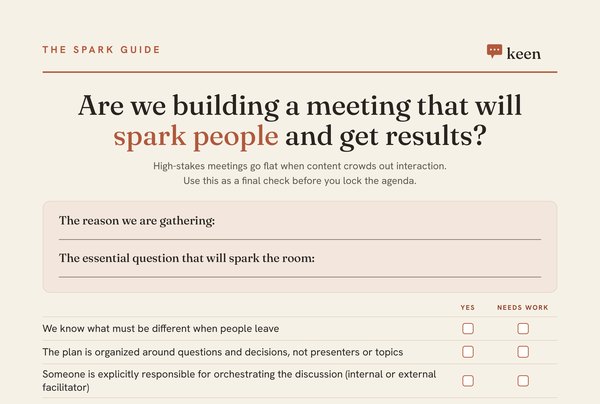
Are you interested in trying this out with your next meeting? Download my “Spark Guide”, a tool to help you design your next high-value meeting. Find out more about how we can work together to bring your meeting to life. Or reach out to chat.